Tuesday, November 29, 2011

Volunteering in Tohoku

When I first heard about the events of March 11th in Japan, I was in shock. This wasn't happening in my country but in one that I loved just as much. The sheer devastation and loss of human life was being transmitted to me from all directions - the news, YouTube, photos, iPhone apps, and friends who were being directly affected.

I wanted to do something even though I was far away, so with help, I was able to organize a bake sale fundraiser that was a big success on a small scale. When I learned that I would indeed be coming back to Japan via the JET Program, I knew that I eventually wanted to travel to Tohoku to see it all for myself.

Unfortunately, many of the volunteer trips either took place in the summer before I had arrived, or required too many days. I knew I could always make a trip for myself but I didn't just want to see it, I also wanted to help in some way. Just as I was about to give up until the spring, a post in one of the many JET affiliated Facebook groups gave me the perfect opportunity. An individual by the name of Naomi Murakami acts on her own to help the people of Tohoku. All the way from Hyogo Prefecture, she contacts groups and organizations on her own and offers to be of service. She enlists the help of others who are also interested and together, they put up their own time and money to plan different excursions and ways to volunteer.

On this occasion, we were introduced and the three of us traveled together to Sendai, Matsushima, and Ishinomaki in Miyagi Prefecture. We were only there for a total of two days, but I really felt like we accomplished what we set out to do and contributed, albeit in a small way, to the recovery efforts. 

We headed out early Saturday morning from Itami airport in Osaka and two hours later were in Sendai Airport. From the air, we could see how the coast was completely flattened, but once we got closer, we could see that it was a bed of trees that had been completely bent by the force of the tsunami. Upon seeing the distinguishable wavy architecture of the Sendai airport roof, I was immediately reminded of a YouTube video I saw that showed the airport being completely inundated and large aircraft carriers being swept away like toys. The interior though portrayed none of that as rebuilding modes of transportation were a top priority in the weeks following the disasters. 


We rented a car and met up with Naomi's friend, Reiko Kamisaka who is a copy writer in Natori city. She led us just outside the airport where the devastation was immediate. The airport and the immediate surrounding area were among the hardest hit in Sendai. The sheer emptiness of the place makes you almost feel like you're on a construction site, but instead of partially built homes, you see partially destroyed ones... Also, now that I am a teacher and because most Japanese schools look similar, seeing schools in the damage was especially difficult. 


From this point, we headed to a Natori City's important cultural property that dates back from the Edo Period of Japan (1603-1868). The couple that maintain's the building is a friend of Reiko's and so she offered to give us a private tour. The building is an amazing relic from a time long ago that was fortunately spared but not without some damage.


Although we went to Tohoku to volunteer, I was glad we had some extra time to see things like this in order to gain a full appreciation for where we were and how these areas were affected. Next though we did head out to where we were scheduled to volunteer; at the Sendai Shichigou Shimin Center, a kind of day care for kids. We were joined by another volunteer group who happened to be there the same day called Bouken Hiroba and Smile Japan. Many of these children were from nearby Shichigou Elementary School where we heard from the adults that many of them watched their friends be carried away by the tsunami. I say heard from the adults because the kids don't like to talk about it. Not that we were prying, but when they asked why we were there, we would explain. Trying to add to the conversation, they would make a comment about where their mom or dad was, but when we would ask about themselves, they would change the subject. Reminding them of that day was not what we were there for, so we proceeded to have a full day of playing games, eating snacks, singing songs, and giving them little presents. 

For me, the whole point of this trip was that even if the people we came across didn't put it into words, I hope that somehow they internalized the message that they're not alone. People from other parts of Japan, even us from the other side of world, want to see them recover they best they can and have a happy life.


A story that has stayed with me since I left, is that of this man pictured here in the red jacket. His name is Makoto Suzuki and he is a worker for Sendai City Hall. He lost his wife and his wife's family in the tragic events. He told us this over lunch which he insisted on treating us to. His work now is primarily trying to relocate people and re-appropriate the damaged areas. However, he is constantly met with opposition from the people themselves because they are reluctant to leave and want to rebuild instead. On the weekends he lends his time to doing this kind of volunteer work as well. Naomi commented that since she last saw him, the weight of his burdens seemed more apparent on this shoulders. If this is is true, I fear for this man in a different way that need not be said. He is in my thoughts, and we plan to send him a Christmas card to continue the 'cheering spirit' we brought there.


Pictured above are some Thanksgiving hand turkey cards I had my students make for these kids. Although both the givers and receivers where not entirely sure what a turkey was, my high school students enjoyed coloring for a change and these kids enjoyed laughing at the "creative" cards they saw. I mean, do these look like turkeys to you?! haha! At least they got the 'cheering' message across..


That night, we went to dinner by Sendai Station. While in search of a Starbucks in the station, I came across  a most fitting exhibition showcasing before-and-after and recovery effort pictures from the disasters. Although I couldn't read the descriptions, I knew enough kanji to figure out where and what was happening in the pictures. I had seen pictures like this on the internet before, but now that I had actually been to some of these places, it was even more shocking. From looking at these pictures I realized a couple of things that I hadn't realized before - the extent of the damage and the incredible progress. Some before pictures showed islands and inlets of the area that are just gone now - not damaged, but underwater. Also, I mentioned before how modes of transportation were the top priority to be repaired, but it was amazing to see the kind of efficiency with which this was carried out! The example below shows that in two days this mangled road was brand new.


The next day, we woke early to head the two hours north to Ishinomaki. Although the tsunami's damage spread across three prefectures and many towns, Ishinomaki experienced the most damage and loss of life. We set out to a temporary housing facility called Higashi Matsushima Hibiki Kasetsu Juutaku to make ourselves of use in any way possible. We arrived and after surveying the grounds briefly, we were asked to help move kotatsus (heated tables), blankets, and heaters from the storage room to the place where residents could pick them up for use. Afterwards, we went about cleaning the community center of the facilities since the people who work there are much too busy with other things. Another small volunteer group was there offering free facials and other spa-like treatments to the women tenants. I think little things like that help take people's minds off of their troubles and makes them feel good, even if only for a little while. We noticed on the map of the grounds that some houses were bigger than others. We figured these must be for families while smaller rooms are for couples or singles. Either way, the houses are not that big or allow for much privacy as they are paper thin. November is not the coldest month but we were already distributing the kotatsus and such because the temporary homes also do little to keep out the cold.

These people are the ones that lost everything. They are starting from scratch. Many have been asked to go live with family in other parts of the country if they can, but understandably, many don't want to leave their town or be a burden to their other family members. Most of these people used to work along the coast and their jobs are now too far away to commute to. They get meager stipends (¥40,000 or about $515 for three months) of relief from the government that are not reasonable at all to actually live on, just maybe to get by. Naomi explained to us that a lot of the donated money is still sitting with the charities that collected them as they are still finding the best way to distribute it evenly and use it most efficiently. Like I said, this disaster affected a very wide area. It is not as simple as giving it to one town or community. We're talking huge cities like Sendai down to small fishing villages like Minamisanriku. These are also some of the problems that Makoto is faced with. It is a daunting task, but these people need help if they are to move on with their lives.


Above are pictures of people work there (with the exception of the tenant who is picking up supplies). The older man in the green vest is affectionately called 'Otousan' (Dad) and we were essentially working with his group, Yappshi Tohoku, that day. The bottom picture shows Naomi with an older couple who decided to reopen their grocery store on the housing property for the convenience of the residents. Seeing that we were volunteering, they gave us figs and tea. They really didn't have to but it goes to show how generous these people are even with the little that they have.

From there we had some time before we were scheduled to go to anther day care, so we were told that we should see some of the coast nearby. We headed to areas that were once known for their beautiful beaches, but are now devastated. Very near to each other were two extreme examples of tsunami preparedness. In the area of Oku Matsushima, the story had always been known of the tsunami that came and wiped out the town many years before. Heeding the moral of this well-known story, the residents waited for no warning after the earthquake before heading to high ground. No one in this village died. Close by though, many villagers in a town were not so fortunate. Littered beaches, piles of rubble, over-turned houses, people taking refuge in caves, lasting faith, hope to rebuild, four-legged survivors...these were just some of the things we saw on the coast.


The day care we went to in the afternoon, Chibikko, had few kids since it was a Sunday afternoon, but that allowed for more one-on-one time with the kids to be able to have snacks and play UNO. These kids are a true example of resilience. Because they are children, I will not say their names, but they were laughing and smiling with us when only a few months before, each of them had lost a parent and/or grandparents. Two of them were students of Kadowaki Elementary School where a fire had broke out during the earthquake and was then flooded by the tsunami. Seven of the classmates perished and they were forced to spend the night in the school since the flood waters hadn't receded. Throughout the night they heard pleas of help from other victims outside that gradually went quiet. Like a friend of mine said, no child should have to go through something like this but at least their time with us was spent laughing and being a kid. After we left the day care we were going to head straight to the airport, but they had told us that their former elementary school was close by so we went to take a look for ourselves. It is completely surreal to think of the terror those kids felt and then to see the place where it actually took place. I saw a couple with their arms around each other walking around the school grounds. I couldn't help but think that maybe they were the parents of one of those lost children or had maybe known them.


As the sun set, we made our way back to Sendai to get on a plane and head back to our reality where neighborhoods are intact and people are not weighed down by the memories of these most horrific events. Even in the same country, it's easy to forget about these people who have suffered so much while we go on about our daily lives as they struggle to do the same. My time there is one that I will carry with me and already value greatly, but I hope sharing my experience sheds light on the current state of things and spreads awareness of the ongoing need for recovery. For more pictures not seen on this blog, click here.

頑張ばれ東北!がんばるぞニッポン!!Do you best Tohoku! Do your best Japan!!

Fall in Japan

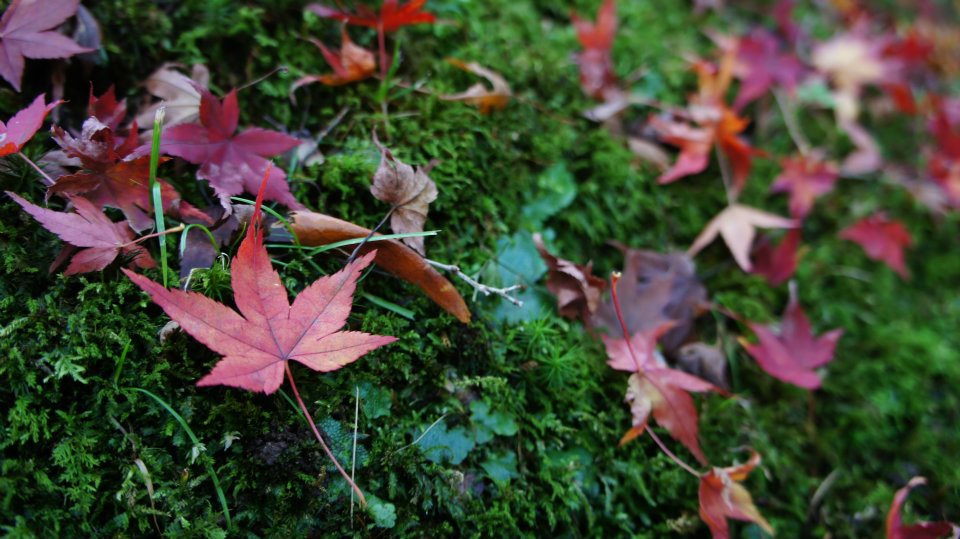
Before we are any further into winter, I'd like to take a minute to comment on fall in Japan. It is beautiful!! Japan is often remarked as being a country that truly experiences all four seasons. Japan is well aware of this and thus there are many indications of what season you are in when you're in Japan. Seasonal foods, products, festivals, and clothing are just a few of the indicators that would let you know what season you're enjoying.

This was my first time experiencing a real fall season. I could feel the warmth slip from the days and realize I needed to start carrying a jacket around. The first time I had to bring out the heaters had me nervous since it was only November! How will I survive winter?! Anyways, although fall is literally happening everywhere, from the trees at my schools to the mountains in the distance on my ride home, Kyoto is one of the most popular places for autumn leaves (known as koyo in Japanese). The colorful trees are breathtaking enough but coupled with Kyoto's old corridors and ancient temple halls, it becomes a postcard in front of your eyes. See for yourself! I went to Tofukuji, Mt. Takao, Eikando, Shinnyodo, Manshuin, and Enkoji over a span of two days.


Sunday, November 6, 2011

Hikami High School's Cultural Festival!

So many exciting things have been happening, but I've been occupied lately with a series of challenges on my personal blog, a.muse.d *sorry!* (now go check it out, hehe)

Earlier this month, my school had one of it's two biggest festivals, the bunkasai or cultural festival. (the other big festival is sports day). I was not only looking forward to this because it landed on a weekday, meaning that I wouldn't have any classes, but also because my school's bunkasai would definitely be unique due to the agricultural aspect of my high school. This meant that the students made food products from our own cows, chickens, and pigs; made these products using skills they had learned in their cooking courses; and were showed off vegetables and plants that they had grown themselves. Also, the girls from home economics had a fashion show with outfits they had made themselves. The clothes looked great but the show itself was hilarious!!

Adding to the fun, my students, who are usually semi-comatose in class, were excited and talkative. My bf was allowed to come so they were all curious about him and gushing at us, making hearts with their hands and saying "ラブラブ!" (love love!) which is something you would basically say to any cute couple...but especially us. ~.~ Another ALT friend came as well, so we all had a good time walking around being appreciated for merely being the only foreigners there and being sucked in by the students to buy from their stall. (er, wait, that was just me..)

Everything was delicious. I know this because like I said, the students pulled me into every stall to buy from them. I ate a version of katsudon, oreo chessecake, cream pan, salmon nabe, karaage, consume french fries, caramel popcorn, and milk. The milk was the only thing that I didn't like because it tasted like strawberry. That doesn't sound bad but when you take a huge gulp anticipating milky goodness, it can be a little off-putting. I also took home mochi, strawberry jam, and soba noodles.

But I wasn't pigging out the whole time - there were activities going on as well. The school's brass band which is lead by my supervisor JTE, Taniguchi-san, played nice renditions of Pachalbel and AKB 48. The school had also hired two performers to come and do their act for the spectators which, even without being able to understand all the Japanese, the slapstick comedy and juggling fire batons was fun to watch. Easily entertained as I am, I also quite enjoyed a contest to collect various stamps from posts set up around the school. The first 10, then 25, then 100, etc., people to get all the stamps got a prize of varying scale. The biggest prize was one of the house plants that I had bought anyways, so I was in no rush. In fact, I didn't need a prize at all, just the satisfaction of collecting all of the stamps was enough to satisfy my compulsion for perfection for me.

I should mention that this was the last day out of three for the bunkasai. The first day was just an opening ceremony (something that is done for nearly every occasion in Japan) and the second day was conducted entirely in the gymnasium. In the gym, each class sang songs and presented projects they had been working on all year. True to form, on the last day there was a closing ceremony as well.

Little things like this have made me appreciate my placement in this quiet little town. These are definitely unique experiences that I might now have had, had I been placed in a bigger city like I wanted. I have to make the most of it while I'm here!

Points for Tamba and Hikami High School!

Hikami High School

Our student body

The Fashion show

The Fashion Show with some teachers who volunteered

Their personal reports on their projects

Home made oreo cheesecake

Class 2-2, selling home made cream pan

Third year girls selling pins they had made for Tohoku Relief


Candy apples or as they like to say, ringoame リンゴあめ

Fresh pork meat..Mmmmm

One of the vegetables a student grew from a seedling

The bunkasai took place in every part of the school

Student artwork on display

Student crafts

Some of my second year boys selling their mochi on the go

First year students have chado 茶道 as an elective

The home made jam and milk

The entertainers doing their fire juggling act

Salmon nabe

Chi-tan! the Tamba city mascot. This was the project of one class who made him out of painted  pet bottles. 

All of the stuff I bought from different booths.
I couldn't say no to my students >< 

Honey Bunny Bon Bon

As promised, this is the story of how I got honey bunny bon bon.

The story last left off with my boyfriend and I having the best weekend in Japan so far while in Wakayama. On our way back, we stopped in Osaka for dinner. I wasn't that hungry, so we walked around for bit before deciding on a place to eat. This very serendipitous decision led us to come across a pet store. My eyes found guinea pigs, hamsters, and then I saw them - rabbits.

Now, before I even came to Japan, I had been wanting a pet rabbit, but with the prospect and eventual acceptance to come to Japan, I obviously wasn't going to buy one in Miami. However, I had definitely considered buying one in Japan since I was going to be here for at least a year. After I arrived though, a pet was the farthest thing from my mind. Adjusting and surviving became more of a priority. However, once I started to become accustomed to my new life, my thoughts returned to getting a bunny, especially since I had been missing my miniature schnauzer from back home. This coupled with my trip to the bunny cafe in Nagoya fueled my wanting a pet despite my limited time in Japan. That being said, I still wasn't actively pursuing it, just giving a lot of thought.

This pet store had quite a variety of rabbit types from the long hair, floppy eared kind to short eared miniature dwarfs. I had a dwarf rabbit as a kid, plus I don't have a backyard, so I went straight for the latter. There were only two mini dwarfs to choose from - one that was white with black patches and one that was light brown with a white trim. I was more attracted to the white and black one since it was the smallest, but when I asked the sales clerk, she said that it was already sold and waiting to be picked up. I was admittedly disappointed and thought that maybe this wasn't the serendipitous chance I thought it had thought it to be. At this point, we went to dinner and talked about it the whole time. I thought life was being cruel to lead me to bunnies and then not let me have the one I want. Despite this feeling, we went back after dinner. The sales clerk saw me looking at the bunnies again so she came over and opened the cage. The little brown one came running while the white one stayed behind.

THIS was the sign that I should have been looking for. When I got Joey (my mini schnauzer back home), almost nine years ago, he had also been in a cage with only one other of his kind and he ran right up to me. Bunnies can be quite nervous creatures so they don't typically run right up you off the bat. Seeing him up close, I fell in love. I certainly hadn't been thinking when I left that weekend that I would be returning with this adorable little bundle of fur, but it was looking like that was the case. But, fate had one more hurdle to jump. Because of the unpreparedness on my part, I didn't have enough cash on me to buy him and all of his essentials. I don't have a Japanese credit or debit card (just a cash card that can I use at ATMs) and it was almost closing time for the pet store. Thus began my frantic run around Namba station in search of a convenient store.

My crappy little bank has no branches outside of my area, so whenever I'm in another town, I have to hope that my card is accepted (always with a additional fee) at different ATMs. I ran to three different chains of convenient stores before I found one that took my card. During that time I was cursing fate yet again for being so cruel, but quickly took it back once I had the cash. I rounded the total up in my head and took out a bit more than what I had calculated. Once we got around to picking out things for the bunny though, I realized that what I thought had been a special for a cage with some basic essentials in it, was actually just a set up for everything you would need for a rabbit. This meant that I had only calculated for the cage and not anything else he needed like a food dish, water bottle, pellets, hay, a hutch to sleep in, litter, etc so I asked the clerk in Japanese what he needed for just the night. I already looked a frantic mess after my running around plus the store closing which made me seem like I was even more in a rush, so the clerk appeared apprehensive. He was probably wary of whether these foreigners were really going to take care of the rabbit correctly, so I wanted to explain the situation but I was quite literally out-of-breath. [As a side note: we bought the rest of his stuff the next day and ended up back at this station on another occasion so we stopped by and showed the clerk pictures of how happy and big he's growing]
Baby Bon Bon at 1 month old!

So I finally have a bunny!!! She had me sign a paper and give my name and address. In return I got a paper stating what type of bunny he is and when he was born. This turned out to be the last sign I needed. He was born on the Japanese holiday of Obon, August 16th. This is a holiday that turned into a nightmare for me the mere month before. Long story short, I had been looking forward to seeing daimonji lit on fire in Kyoto during Obon for four years. I had never been in Kyoto, let alone Japan during the month of August so I was finally going to get my chance. Due to a minute error, I missed the lighting ceremony by only half and hour. I had a special reason for wanting to see this event, at this time, with a certain person, but it didn't happen. I can't express how devastated I was to miss this event...

But lo and behold, on a day of great sadness, a great happiness was born. Thus his name would be bon bon.
The honey bunny came later for dramatic effect. ~.~